


Three weeks after the food photography workshop, you’re setting up a shoot and you catch yourself working differently. Not thinking differently – working differently. Your hands know what to do before your brain catches up. That’s when you realise something actually changed.
But let’s back up to what creates that shift in the first place.


The First Hour
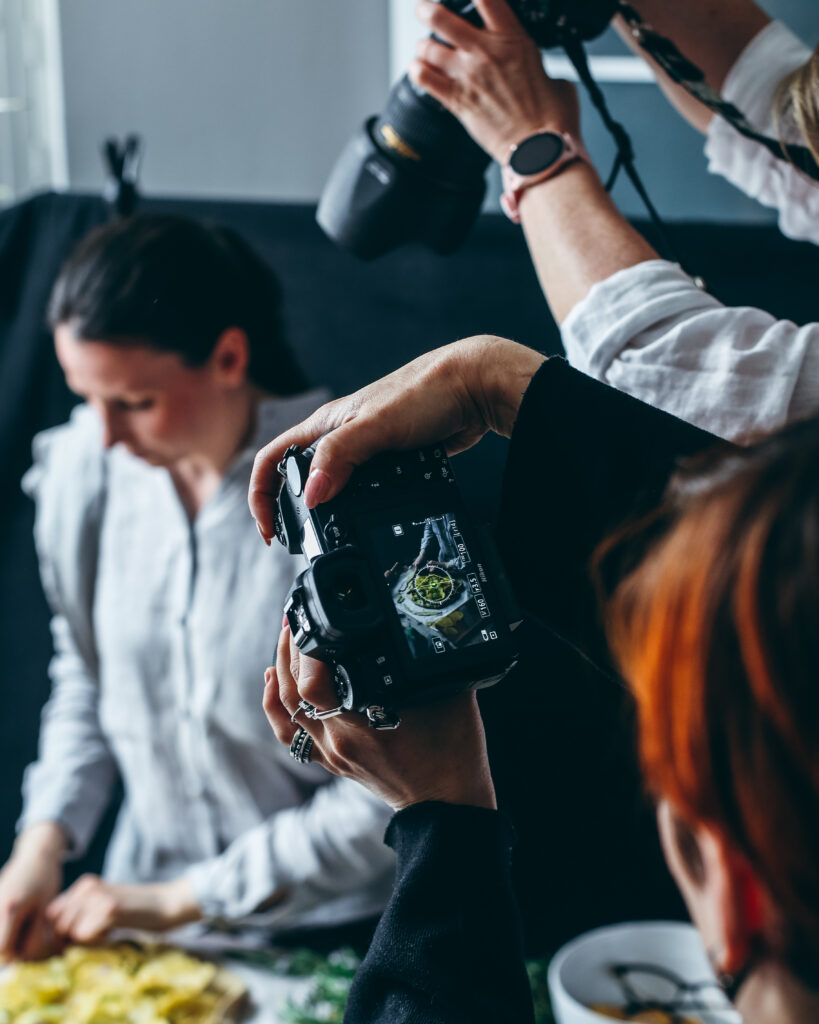
We start with coffee and introductions, a casual conversation while we set up the first scene together. You watch how we approach styling in a real BTS – not because we’re demonstrating, but because we’re actually working. Building a food photo composition from scratch, making decisions out loud, sometimes changing our minds.
This is when you realise teaching isn’t about us showing off. It’s about you seeing the styling and storytelling process, mess included and truly learn from the process.
When It Clicks
Mid-morning is when we stop talking and you start shooting. We’ve set up a scene, now it’s your turn to work with it.
This is where real learning happens – you try something, we adjust it together, you see immediately what changes and why. The questions that come up are the ones you actually need answered. Not theoretical “what if” questions, but “why isn’t this working right now” questions. Those are the ones that break through the walls.
You’re fully supported in trying different approaches – until you find your way.


The Afternoon Breakthrough
By lunch, the room feels different. People are showing each other their shots, genuinely excited about what they’re capturing. Collaborative and excited. Someone figures out how to fix a shadows and immediately shares it with the person next to them.
This is the part we can’t manufacture. The community builds itself.
The afternoon is when you create the image you came for. The one that makes you think “I did that. You see it in your camera and you know it’s good.
What Changes
Here’s what people tell us weeks after the workshop:
They stop second-guessing every choice. Not because they suddenly know everything, but because they trust their instincts enough to try something and adjust if needed.
They look at their old portfolio and understand what was missing. Not in a harsh way – more like “oh, that’s what I was trying to do, now I know how.”
They shoot more. A lot more. Because when you understand the principles instead of just following rules, experimentation becomes fun rather than frustrating.
The Subtle Shifts
The transformation isn’t dramatic but is deep. You don’t walk out immediately a different photographer. But you walk out motivated FINALLY knowing you can figure things out. That when light isn’t working, you have tools to fix it. When composition feels off, you understand why. Confidence builds, finally.
You stop comparing your work to others’ and start acnowleging your growth from the six months ago. That “comparison” feels good.
Why It Has to Be In-Person (And Why It Doesn’t)
I teach an 8-week online course that I’m extremely proud of. It’s more economical than a workshop, goes deeper into each concept, and students achieve remarkable results working at their own pace.
But the in-person format compresses months of learning into one intensive day. When you’re in the room with multiple teachers and assistants all focused on your growth, you can’t hide behind “I’ll try that later.” And seeing things done instead of hearing an explanation makes a total difference. It’s a fast growth, you see the results immediately.
And the connections that form when you’re working alongside other photographers – sharing frustrations, celebrating breakthroughs, troubleshooting each other’s setups – that community builds itself in person in a way it just doesn’t online.
The online course transforms you over eight weeks – affordable, self-paced, in the comfort of your home. The in-person workshop transforms you in eight hours – pedal to the metal, uncomfortable, takes you out of your shell in one powerful go. Different experiences, both valuable.


The Weeks After
The first few shoots after the workshop, you’ll probably still overthink some things. But you’ll notice yourself pausing less, making decisions faster, trusting your instincts more.
Maybe two weeks in, you finally find your stying pace A month later, someone comments that your feed looks more cohesive. You hadn’t even noticed – you were just shooting what felt right.
The transformation is unstoppable, you keep growing. And it’s genuine, which means it sticks.
Is It for You?
If you’re reading this thinking “I’m not good enough yet” or “maybe next year when I have more experience,” consider this: everyone at the workshop feels some version of that. The beginners worry they’ll slow everyone down. The experienced photographers worry they should already know this stuff.
Neither fear is accurate. The beginners keep up fine. The experienced photographers always find gaps they didn’t know they had.
The workshop works because everyone’s at a different place in their journey, and that diversity makes the learning richer.
What my students say:
Extraordinary depth with multiple ‘Aha!’ moments. Victoria, Aumni
I was a bit scared to come to the workshop, I was thinking everybody was going to be full-blown photographers. How wrong I was! Reel and Photography 2 days Workshop with @thelitteplantation
Silvia opened up the joy of exploration and taught me to create journeys, not just photos. Like a searchlight of clarity – incredibly inspiring! Brigid – PCS Academy
I understand so much better about food styling and creating shots – I learnt masses …I am still absorbing, it was really useful for me. Reel and Photography 2 days Workshop with @thelitteplantation
Silvia is incredibly passionate and creative, with a vast background in design, art, and photography—she knows exactly what to teach and how to explain it clearly. (alumni) Marco – @mi_dulce_boutique


The Practical Stuff
We keep groups small – usually 6 to 12 people – because individual attention matters. You’ll get hands-on time with professional equipment in spaces with incredible natural light. We provide all the food, props, and styling materials.
You’ll leave with portfolio-worthy images, but more importantly, you’ll leave with the understanding to create those images again on your own.
– Why Workshops Cost What They Cost
In-person workshops typically run around £1,000 or more. That’s a significant investment, and you should understand what you’re actually paying for.
The obvious costs: venue rental (especially for spaces with incredible natural light), all the food we style and eat throughout the day, ingredients, props, styling materials. Then there are two or more teachers dedicating a full day to 6-12 people.
The less obvious costs: days of preparation beforehand. Planning curriculum, coordinating with co-teachers, sourcing seasonal ingredients, testing setups, preparing the recipes. A one-day workshop requires at least three days of prep work behind the scenes.
But here’s the reality most students tell us: they recoup the investment in their next one or two paid sessions. The clarity you gain about your process, the confidence to charge appropriately, the portfolio work that attracts better clients – these translate directly into your paid work. You’re not spending £1,000 on a workshop. You’re investing it into immediately improving how you work and what you can charge.
The online course costs less because the preparation scales to hundreds of students. The in-person workshop costs more because it can’t scale – it only works with small groups getting direct attention. Both are investments in your work, just with different timelines for seeing the return.
What You Need to Bring
Your camera, your curiosity, and maybe a willingness to let go of the idea that there’s one “right” way to photograph food. That’s about it.
The rest – the confidence, the community, the clarity about your creative direction – we will be there to help you build it all over the course of the day.
One More Thing
People always ask if one workshop is enough. Honest answer: for most people, yes. But what “enough” means depends on where you are.
Workshops aren’t just about accumulating knowledge – they’re about getting inspired, feeling supported, and realising other people struggle with the same things you do. That sense of companionship matters. We work alone most of the time, so these nurturing moments become vital.
If you’re just starting, one workshop won’t turn you into a professional overnight. But it will give you months’ worth of practice direction and the confidence to implement what you learn. You’ll know what to focus on instead of shooting in the dark.
For experienced photographers, one workshop usually breaks through the specific barrier that’s been holding you back. You leave with a clear path forward rather than vague dissatisfaction with your work.
Either way, you leave different than you arrived. Evolved, not just transformed. And that evolution continues long after the workshop ends.
If you’re considering joining us for a workshop, that means some part of you already knows you’re ready for this next step. Trust that instinct.
We’d love to have you in the room.



+ view comments . . .